Watch, Scroll, Repeat (AURA stories 4)
Life under instant, low-effort, portable reinforcement

A plugged-in world
Booking a plane ticket when the internet appears and disappears is an exercise in surgical hand-eye coordination. Eyes fixed on the lower right corner. Finger hovering over “enter.” Wait for at least two bars to return. Press.
“Transaction completed.”
Victory!
She has not been back in her home country for years, but this time she cannot delay it. Her mother is moving into a retirement residence, 5-stars of course, and has left Sage with the dismantling of a life: packing family relics, clearing drawers and wardrobes, renting out the apartment.
At the airport she buys a SIM card from a vending machine and slips it into her Nokia. A relic now. A stubborn one.
The road from the airport to the capital still draws her in. Scattered houses chasing the tall blocks of concrete and glass, bridges stitching neighbourhoods together. As a child she used to watch the world through the car window for hours and call it her street-TV. It was her favourite form of entertainment during those long drives when her father, in his battered old car and under express orders from her mother, delivered Sage and her sister to their grandparents’ house by the sea for the entire summer.

They would plant their faces on the rear window and pull funny expressions at the drivers behind them. Sometimes someone would reciprocate with a quick flash of a tongue, and the two sisters would duck down and collapse into laughter. Other times the three of them would build a story together, each taking turns adding a sentence. Her favourite had been her sister’s creation: a family living in the sewers, a hidden world of wise rats and mysterious smells. The story made little sense, but that was never the point.
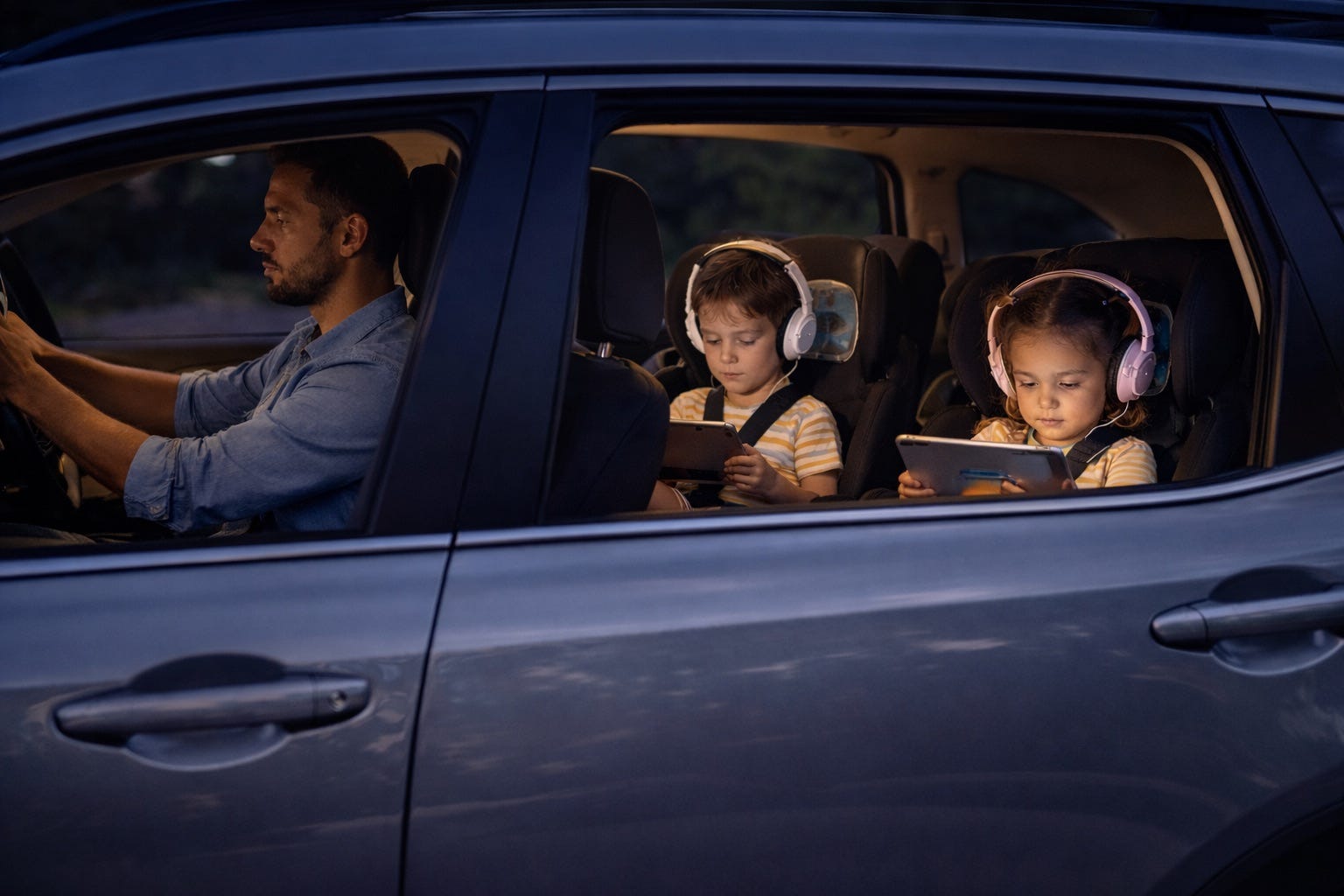
The taxi stops at the red light and Sage glances into the car beside her. A family. The father, hands on the wheel. The mother, tapping on her phone. Two children in the back, each facing a screen mounted on the back of each seat in front of them, headphones large enough to cancel the world outside, and inside.
The house reflects her mother’s theatrical temperament, a cocktail of antique and ultramodern. On the eighteenth-century desk, a piece passed down through generations, she finds a professionally wrapped parcel with her name on it.
“Welcome back to the twenty-first century. Without this, survival will be difficult.”
She opens it. The bitten apple on the cellophaned wrapped box leaves no room for doubt: the latest iPhone. Sage rolls her eyes.
Her mother still doesn’t understand that Sage is not opposed to technology out of principle. Her laptop is the newest mode and would be coveted by any professional gamer; her beloved air conditioners are digital and remotely controlled. What she resists is the moment screens stop serving the person who turns them on and begin to lead, quietly replacing what human beings might otherwise learn for themselves.
For a woman who never learned to cook, Sage distinctly remembers the smell of boiled aubergines, her mother’s kitchen looks as if it has been lifted from a catalogue on futuristic home design. Even the refrigerator speaks.
On the marble island sits an old bronze scale with two plates and small brass weights. As a girl she spent hours weighing the most improbable things: her aristocratic great-aunt’s jewellery, the toy poodle puppy: nine hundred grams.
She places the Nokia on the right plate and adds a small cylindrical weight to the left. Just under ninety grams. On the other, she places the iPhone and watches the plate descend.
The weight of carrying the world in your pocket.
She knows those two opposing plates do not represent a real choice. She knew it the moment she pressed “enter” upon the return of the flickering signal bars, buying a ticket into a system that requires you to play by its rules.
In this arena, time no longer moves between chalk drawings, skipping ropes, and stickers. It moves beneath fingers sliding across glass. And if you do not play, you stay on the bench.
“Rest,” she murmurs, stroking the Nokia as she removes its tiny rectangular soul and transplants it into its new body. She cannot deny the elegance of the world’s most popular smartphone: gently rounded edges, polished screen, luminous colours.
She presses the power button. She turns the key into a world that within minutes lures her in, fully.
Sage stretches her arms and rubs her eyes. She stares at the clock in disbelief. Has she really spent the last four hours inside a screen?
Ping. It’s a message from Clara, inviting her to spend the day at the ABA centre where she works.
Screen-Based intervention
A young woman in a tailored suit and headset greets her. “Welcome, Doctor. I’ll let Clara know you’re here. Here’s your visitor badge. Can I get you something to drink? Coffee? Tea? Juice? Water?”
While Sage waits, a mother pushes the door open with a stroller. A young therapist crouches to the child’s level. “Hi, Sam.”
Sam does not look up. His gaze remains fixed on the screen mounted on a metal arm extending from his stroller. His mother unbuckles him. He clutches the rubber handle of the shock-proof military-grade case and lets out a piercing scream.
“Just a second, just a second — I’m giving it to you,” she says, placing the iPad back in his hands. Silence returns, apart from the music spilling from the device.

Sam gingerly walks down the corridor holding the iPad in one hand and the therapist’s hand in the other. Clara appears at the end of the hallway.
“Sage, so good to have you here.”
In Clara’s office, a large monitor displays four split screens, each showing a child and their therapist. Clara explains that the new AURA audio-video upgrade provides real-time guidance. Each educator wears an earpiece. AURA informs, corrects, and delivers individualized feedback in the moment.
Each room contains a small table and two chairs, a cabinet with materials and games, a rug, a mini-trampoline, a large bouncy ball. Bright. Tasteful pictures on the crayon-free walls. Everything seems to have just come out of a box. Intact. Sage cannot help thinking of her own rooms: chaotic, four or five children at once, mismatched tables and chairs, worn wooden trains, half-chewed building blocks, children occasionally stealing a puzzle piece from one another.
From the monitor she watches sessions conducted with measured precision. No loose papers, no clutter. On the wall screen AURA signals the next set of trials and guides the therapist through every component of the intervention plan. Each movement produces access to the iPad, the object every small student selects whenever their preference is assessed.
There is nothing inherently wrong with that. It is clearly the most effective reinforcer.
Still, Sage cannot help wondering what would happen if the iPad were not available. What else would grow if we stopped feeding the scrolling? Where would the children allocate their movement if it disappeared? Her eyes drift to the toys on the rug, bright, intact, unused.
She turns to Clara.
“Has AURA programmed objectives to condition new activities, to expand the range of reinforcers and social interactions?”
“Yes,” Clara replies. “But the iPad is always the first choice. It’s what motivates them most to reach the targets.”
Clara knows the answer will not fully satisfy Sage. She has been asking herself the same questions. The WHO recommendations for solitary screen use in young children are clear, yet every child in early intervention exceeds them — and not only here. At home as well. Most of their free time unfolds in front of a screen, like it does for the adults around them.
More than once she has wondered what it means to target play if every response occurs to access solitary digital reinforcement.
At what point do we begin to question a reinforcer that appears to narrow rather than expand a behavioural repertoire? And at what point, in privileging what is most preferred, do we risk building exclusivity instead of flexibility? Clara exhales.
“Shall we get lunch?”
“Sage, I’d like to ask for a few hours of supervision while you’re here. We’ll do everything formally, but I need a perspective different from AURA’s. The parents have agreed and signed the consent form. I’d like us to see them together.”
Sage nods.
“Tomorrow’s Saturday. Let’s go at ten if they’re free.”
Clara smiles faintly. “They will be. They haven’t left the house in over a year.”
Phone-Based life
Andy is eleven, a boy with autism on the threshold of adolescence. Round cheeks and bright eyes. He opens the door, mutters a brief “hi,” then turns to his mother.
“Now give me the phone.” Said and done.
Sage and Clara exchange a glance. Clara knows Sage has already sussed the situation.

“Andy lives for the phone,” his mother begins. “It’s the first thing he asks for in the morning. He won’t do anything without it. Even at the horsey therapy centre he sits on the pony with the phone in front of him. If we ask him to hand it over to complete two or three instructions, he gives it back. But after less than a minute he starts asking for it again, insistently.”
“In the house we manage, more or less. We were taught to alternate short chains of instructions with access to the phone. But he still spends hours on it when we can’t stay on top of it. Outside we can’t get it back. He screams. He might even hit strangers, because he knows we will give it to him to stop him. It’s easier to let him keep it. But then what’s the point of taking him out if he’s living inside a screen?”
She pauses.
“We know we can’t eliminate it. We tried. He started waking up at night and searching for it everywhere — in bags, in drawers, in Rebecca’s room, his sister. And everywhere we go, someone has a phone in their hand. It’s a battle with Rebecca too, with social media. But she doesn’t have an autism diagnosis. She goes out with friends, she has a boyfriend, she cares about getting good grades in school. I take it for granted that one day she’ll be independent. For Andy, it won’t be like that. We have to find some balance. Because if he could, he would spend his life scrolling on YouTube.”
Sage listens without interrupting.
“What would you like to do outside with him?”
We’d like to go for a walk. Visit a farm, he used to love animals. Go to the cinema, to a local festival, he used to love dancing and listening to live music. Or simply have dinner out as a family. Go to church… We would like him to take his First Communion. We’d like him to go in the water when we go to the beach instead of lying on a sunbed with the phone, or running up and down the shoreline holding it in his hand.
“He had learned to ski. But the last time we went, we couldn’t even get his boots on. He knew that on the slopes the phone wouldn’t be allowed. In the end we took turns. One of us stayed with Andy, the other with Rebecca. On the drive back we bought three power banks because we were terrified the battery would die. And when the signal dropped in the tunnels, he became so upset we were afraid we might have an accident.”
Sage looks at Andy.
“We won’t work against the phone, initially” she says quietly. “We’ll build something alongside it. What does he watch?”
“At the moment he loves the entire Toy Story series.”
“And where does he watch it?” “Everywhere” Andy’s mum replies.
The first task is simple: establish a fixed, predictable location for phone consumption. No more wandering through the house. The phone belongs at the dining table.
Andy adapts within a couple of days. He can stand, move around, run up and down flapping his hands, but without the phone.
The second step is to bring access under a multiple schedule to regulate availability. Sage knows that once the phone is made freely available, behaviour will be allocated to it almost exclusively, and previous sources of reinforcement will pale in comparison. It is an invincible contingency, especially in children.
She cannot simply remove it. She needs an alternative that produces similar effects.
She explains this to the parents. His mother, a nurse, nods. “So, we need to find his methadone.”
On the next visit, Sage presents two cards, one red one green with a velcro strip on them. When the phone is on the green card, it is available.
When it is on the red card, other screens are available, but without autonomous scrolling. Andy can choose DVDs on an old laptop that he can fast-forward and rewind, but changing cartoon requires some effort and some waiting, or the television, with the remote controlled by his parents.
They sit beside him. They respond to every comment, every bid for attention. They change the video whenever he asks, but slowly, making the transition visible.
Over the following weeks, Andy often remains in co-viewing even when the phone turns green again. Being a human remote controller is not ideal, but the parents begin to see small shifts — increasingly larger pockets of time in which they are interacting with Andy, even if it is still in front of a screen.
Then comes the orange card.
In orange, there are no screens. There are increasingly longer shared activities inside and outside. Taking out the rubbish. Walking to buy bread. Ice cream at the café. A board game. Building a Toy Story Lego set together. Picking up Rebecca from a friend’s house. Sitting through the last five minutes of Mass and walking home.
Sage guides Clara in planning each step. They do not improvise. They do not expose Andy to impossible demands. They insert brief sequences, predictable returns, clear transitions.
Slowly, old behaviours that had seemed to disappear begin to reappear. They are not forgotten. Just unpractised.
The road ahead is still long. The parents know Andy may never manage the phone independently.
But as she says goodbye, his mother tells Sage:
“When something you love begins to shrink your world, it becomes our job as parents to widen it.”
Sage nods.
As she walks down the stairs, her smartphone vibrates in her pocket. Her hand moves automatically toward it, but then pauses.
She withdraws her hand.
She pushes open the door into the courtyard. The scent of blossoming fuchsias rushes toward her. She inhales, deeply.
Sometimes, to make someone truly free to choose, we must first narrow the contingencies that shape those choices.
Author’s Note
This is clearly a fictional story, but not far from what we observe every day. Children in strollers looking at a screen instead of the world around them. Children constantly entertained, who may never learn to be bored or to play with their own imagination.
Sam and Andy are children with autism, but their story is common to many typically developing peers. Children like them are simply at greater risk of not developing broader adaptive repertoires without targeted intervention. Clearly, they are fictional characters, but their story is highly familiar to us. Andy’s intervention is, with the necessary individualizations, inspired by strategies that have actually been implemented on this topic.
Some of Sage’s childhood memories are autobiographical. My sister truly did invent a fantastic story about a family living in the sewers. And our father, who was a great storyteller, loved listening to us. He would perform the voices of the characters and made us feel that what we were saying was immensely important.
This story is dedicated to him and to the wonderful childhood he gave us.
A treatment approach beautifully communicated through story telling. Thank you.